
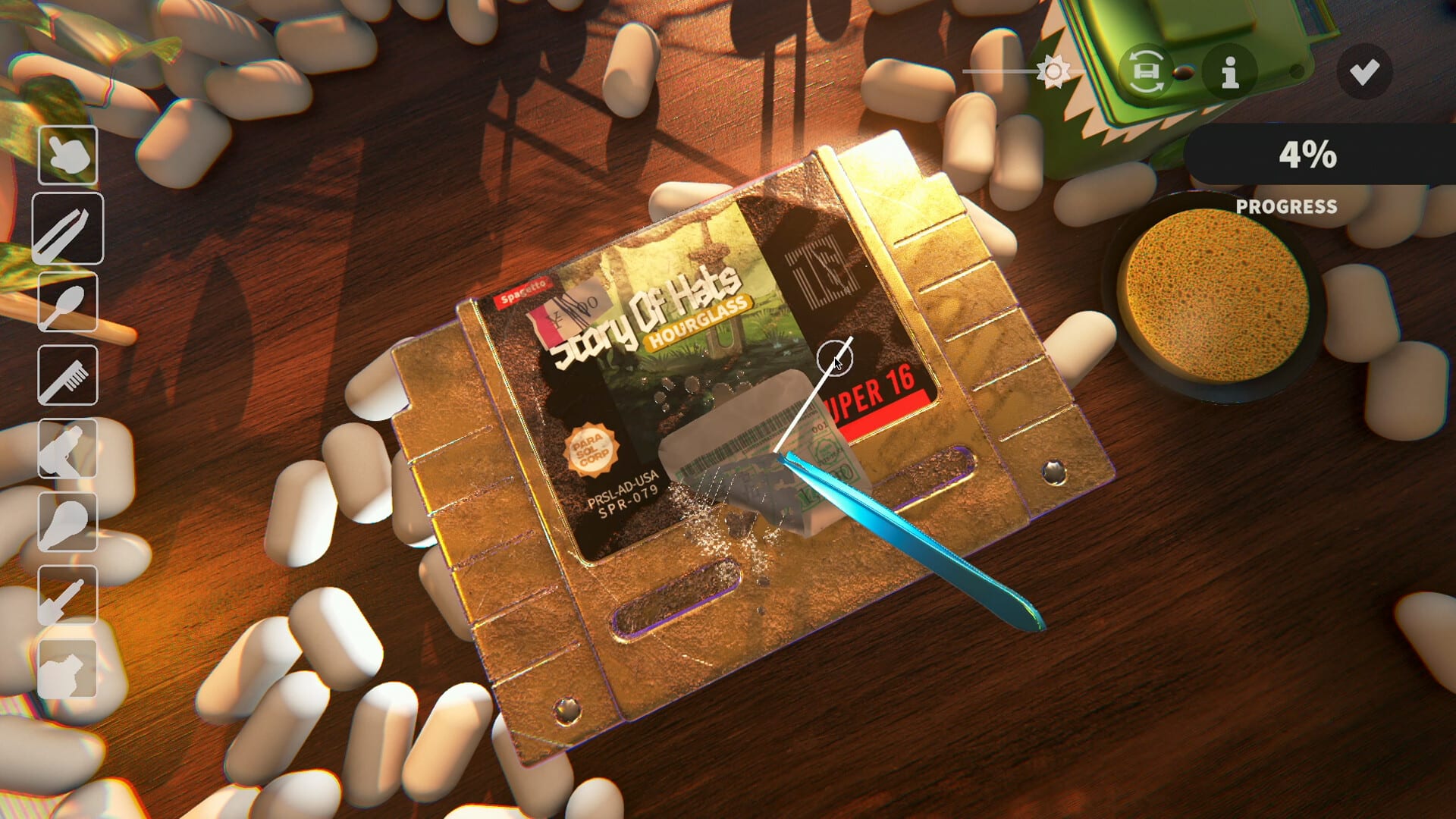
Official screenshot · Steam media gallery · © Parasol Corp. Material statement
Open the parcel and inspect the find
The game delivers cartridges inside mystery parcels sealed with tape, making unboxing part of the restoration rather than a separate reward screen. Open the package and inspect what you have received before choosing a tool. Conditions and visual traits vary, so the next parcel is not guaranteed to repeat the same cleaning job or contain the particular title you want.
The official description separates dust, ink, discoloration, stickers, scratches, and adhesive residue into layers of wear. That gives you a practical way to approach the first object: identify the visible problems, then handle them deliberately. The game has no timer or fail state, so learning the difference between layers is more useful than rushing to imitate a fast cleaning clip.
Match tools to the problem
The researched kit includes tweezers, a cotton tip, a toothbrush, a heating tool, a UV torch, Solvent, and Polish. Tweezers handle stickers, Solvent is associated with ink and adhesive, and Polish is associated with scratches. Use that mapping as a starting reference rather than assuming one bottle or brush removes every kind of wear.
Heating can make stickers easier to peel and reduce the gunk they leave, but exposed adhesive still needs its own treatment. Cotton tips and brushes can become dirty, with hands-on reports describing them spreading grime again if they are not cleaned. The tools reference explains those roles, while the glue and scratch articles focus on the two treatments most easily confused.
Inspect the last patches with UV
The UV torch reveals unfinished work instead of removing it, and the final-demo announcement describes a lingering trail to help you return with another tool. Inspect the object, identify the mark, and then use the treatment suited to that layer. Check other surfaces when the face in front of you looks clean but a category remains unfinished.
Demo Patch 6 introduced a specific autocomplete condition: dirt, ink, scratches, and stickers must each reach at least 99%, with the option enabled in Accessibility. An overall average alone is not enough to establish that condition. If you reach a stubborn final percentage, use the 99 percent troubleshooting page before assuming the item or save is broken.
Decide what to display and what to sell
A restored cartridge is more than a completed cleaning task, because it can become part of the display collection or a source of money. Independent coverage describes selling duplicates to fund more parcels and room upgrades. Compare the usefulness of the item you are keeping with the funds offered for selling it instead of treating every completed restoration as an automatic sale.
This choice matters because displayed games contribute to progression systems and shelf bonuses. A spare copy may be an easier sale decision than a game that is helping the room provide a useful effect. The research does not establish one universal selling formula, so the money guide focuses on offers, costs, and collection trade-offs rather than guaranteed profit claims.
Arrange shelves with bonuses in mind
The developer describes a shelf system that influences cleaning tools, rarity, and the economy. One official example is stacking puzzle games for greater cleaned surface area. Your collection room therefore has a mechanical purpose alongside its decorative role, and moving a game can affect more than the appearance of the display.
Do not assume that progression requires a separate shop where every cleaning tool receives a conventional purchased level upgrade. The researched announcements establish shelf-based effects, but do not provide a complete bonus matrix or exact multipliers. Read the feedback available in your build and consider how a planned sale or rearrangement changes the collection you are maintaining.
Use quests to guide the collection
Collection quests can ask for particular genres, rarities, or arrangements linked to the in-game calendar. The official site gives examples involving puzzle games, rare platformers, and displaying a certain group on a particular day. These are reasons to look at what an item contributes to the collection before judging it only by its immediate sale value.
Quest rewards include decorations and cosmetics for the collection room, allowing your space to develop alongside the cartridge collection. The announced full-game design includes 108 distinct titles with regional variants, while the trial offers a much smaller sample. Do not expect a short demo session to expose the complete collection or every launch quest.
Continue the day without confusing it with a level
After a restoration, the collection room and its shelf nodes are part of the progression flow. Developer replies describe using the door or end-day control to move forward, rather than searching for a hidden numbered campaign stage. Complete the work you want to keep before advancing, because hands-on coverage warns that moving on can discard remaining parcels.
The documented final demo stops after three in-game days and seven available games. Reaching that boundary is different from failing to complete a cleaning category, and expensive demo upgrades do not establish a route around the limit. The next level guide separates the day transition, shelf placement, and end of the trial.
Understand what the demo does not promise
Demo balance is intentionally different from the full game, including the rarity of available items and restrictions on upgrades. Patch 6 also announces a reset in the full game because the demo's collection is tuned differently. Treat the trial as a way to learn the controls and restoration loop rather than a promise that all of its progress will carry over.
This guide combines official explanations with the observations summarized in the supplied research, and it does not claim independent gameplay testing. When your build behaves differently, check the patch and item before carrying an old demo rule into the full release. Start with the official download page if you still need the trial, then return to the specialist articles for the exact problem you encounter.
Choose the specialist page for the next question
Use the beginner workflow to identify the stage you are in, then move to the article that answers that stage's specific problem. A failed sticker clean belongs with glue and tool selection, a high unfinished percentage belongs with category inspection, and a completed trial belongs with the day limit. Those questions can feel similar while you are learning, but the documented explanations are different.
The same approach applies to downloading and settings questions before the first parcel. Confirm the Steam product and supported system, then use the built-in language selector if needed rather than assuming a mod or separate patch is required. The purpose of this starting guide is to connect those verified systems so that your next search leads to a precise answer instead of an invented all-purpose fix.
Sources and version notes
This guide synthesizes the research checked on November 4, 2026. Demo changes and preview observations are identified in the text; this site does not claim independent gameplay testing.
Found an outdated detail? Send a correction with the game version and the relevant source.