
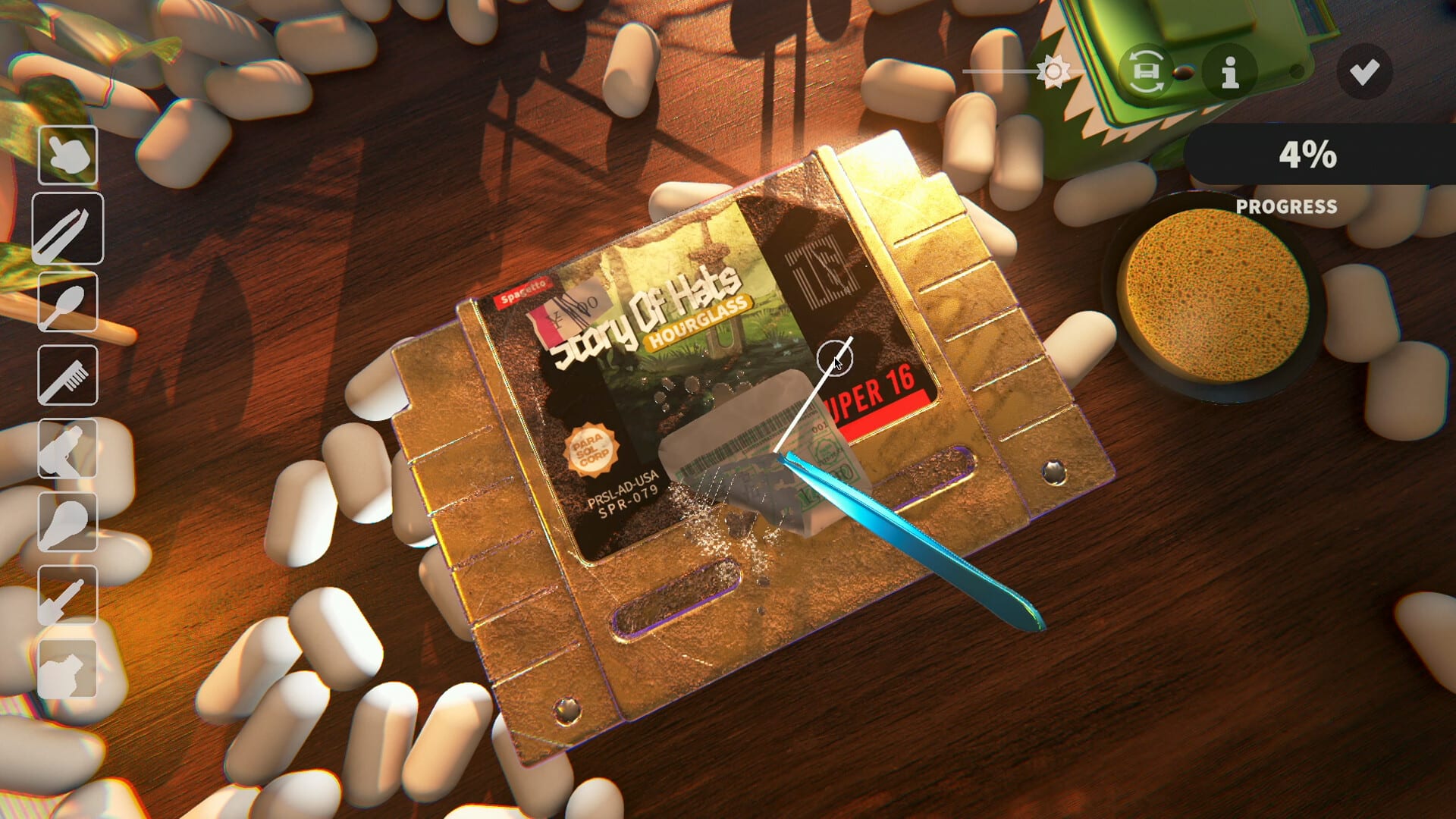
Official screenshot · Steam media gallery · © Parasol Corp. Material statement
Turn restored spares into funds
Hands-on coverage identifies restored-game sales as a way to fund more parcels and collection-room upgrades. Duplicate copies are useful candidates to consider because selling one may be less disruptive than giving up the only copy contributing to a collection goal. That is a decision framework, not a rule that every duplicate must immediately be sold.
Begin with the item you actually have and the offer currently shown rather than assuming all copies have the same value. The game randomizes conditions and visual traits, and the collection system distinguishes titles, rarities, and regional versions. A copy that looks familiar can still matter differently to your collection, so inspect it before treating it as interchangeable stock.
Compare the cost with the current offer
The researched reviews describe daily market changes, while a developer response identifies arbitrage as part of the intended economy. This supports comparing what you paid with the offer available now. It does not establish a universal buying price, a permanent resale ratio, or a guaranteed amount of profit for every cleaning job.
Keep the comparison focused on the decision in front of you: what the purchase cost, what the current sale would return, and what keeping the game would provide. A positive sale offer is not the same as proof that the entire purchase cycle has been profitable. Use the game's current values rather than copying a preview's figures as if they were fixed full-release balance.
Include daily income in the plan
Daily income is separately described in the hands-on research, so selling every useful display item is not the only way money enters the loop. Consider that income alongside sale opportunities when planning another parcel or more room capacity. The evidence establishes the system, but not a permanent payment figure that applies to all later versions.
An early preview's specific daily amount should therefore not become the headline promise of a money guide. The game and demo were still receiving balance changes during the research period. Planning around the current build's displayed income is more reliable than treating one older observation as a guaranteed return for the rest of the game.
Protect shelf bonuses before selling
The developer's announcements describe shelf arrangements affecting tools, rarity, and the economy, including discounts. That creates a trade-off between receiving cash now and keeping the benefits associated with a display arrangement. Before selling a shelved item, check whether it is helping a bonus you are using or a collection objective you are trying to complete.
This is also why an item cannot always be evaluated by sale value alone. A useful shelf arrangement may support later cleaning or purchasing decisions, while selling one component changes the collection you have available. The research does not provide a complete economic multiplier table, so this guide does not assign a numerical future value to each bonus.
Budget for more parcels and room space
More funds can support new parcels and a growing display room, but those purchases serve different immediate goals. Parcels bring another restoration opportunity, while room or slot decisions affect how you organize the collection. Decide what is preventing your next intended action before spending on whichever button happens to be available.
In the demo, that distinction became important enough for the developer to change starting cash after players reported problems buying everything once they unlocked slots. The patch is evidence of trial balancing, not proof of a permanent full-game funding problem. When following a spending recommendation, check whether it comes from a demo session with those specific restrictions.
Why demo upgrades can look unaffordable
Demo Patch 4 deliberately made upgrades prohibitively expensive to keep players from spending limited trial funds on them instead of games. An extreme-looking demo price is therefore not automatically a sign that you are missing a money exploit. It can reflect an intentional restriction on the trial rather than the intended cost of an ordinary full-game purchase.
Patch 6 later increased starting money and explained that the demo's item rarity was tuned differently from the full game. Together, those changes make old trial prices a poor basis for calculating a release-version grind. Do not infer a hidden unlock requirement or a fixed earning rate from an economy the developer explicitly adjusted for the demo.
Keep quests and collection progress in view
Collection quests reward decorations, and some depend on holding particular kinds of games or displaying them on in-game dates. Selling a game that appears expendable can therefore affect a goal beyond the immediate cash total. Look at the active collection need before deciding that the highest current offer is always the most useful choice.
The research does not establish cash rewards for every quest, so decorations should not be rewritten as a universal money payout. Instead, consider the two systems together: sales and daily income fund the operation, while collecting and quests shape what you may want to keep. The beginner guide explains that broader loop without turning every activity into a profit formula.
Avoid confusing progression with an exploit
No infinite-money technique, guaranteed profit per minute, or verified trainer method is established in the supplied material. A high-value sale in a preview does not prove that the same transaction can be repeated indefinitely in every build. The useful information is the documented economic structure and the trade-offs you can inspect in your own game.
If you have reached the trial's three-day limit, earning more money is not evidence that you can unlock additional demo days. The next level page explains that separate boundary, while the tools page covers collection effects on cleaning. Keep those questions separate so that a demo cap does not turn into a pointless search for an unsupported upgrade or cash requirement.
Review a sale in the context of the collection
Before confirming a sale, identify whether the copy is serving a current collection need, a display arrangement, or simply another opportunity to turn completed cleaning into funds. That question reflects the documented tension between selling and keeping games without assigning an unsupported cash value to a particular shelf bonus. A useful decision can differ between players because the collection already on display differs as well.
Afterward, compare the next purchase with the goal you are trying to advance rather than treating the cash total alone as the measure of progress. A new parcel, more room space, and keeping a quest-relevant game solve different immediate needs. The research supports considering those systems together, while leaving exact optimal routes and guaranteed returns out until they have evidence tied to a specific build.
Sources and version notes
This guide synthesizes the research checked on November 4, 2026. Demo changes and preview observations are identified in the text; this site does not claim independent gameplay testing.
- The Wand Report: income and changing sale prices — review summarized in the research dossier
- MKAU Gaming: duplicate sales and progression
- Developer response: arbitrage and shelf bonuses
- Developer: Demo Patch 4 upgrade restrictions
- Developer: Demo Patch 6 starting cash changes
Found an outdated detail? Send a correction with the game version and the relevant source.